Affordable Dental Implants in Ventura: 2026 Guide
Table of Contents
- How to Find Affordable Dental Implants in Ventura: Start Here
- What You'll Need Before You Start Comparing Implant Providers
- Dental Implant Treatment Steps: From Consultation to Final Crown
- Dental Implant Consultation Questions to Ask Before You Commit
- Dental Implant Insurance Coverage: What Plans Usually Pay For
- Dental Implant Financing Options and Lower-Cost Alternatives
- What to Avoid When Comparing Implant Providers
- Your Next Step Toward Affordable Dental Implants in Ventura
- Frequently Asked Questions
Last Updated: October 7, 2026
How to Find Affordable Dental Implants in Ventura: Start Here
Finding affordable dental implants in Ventura starts with understanding what drives the cost and which questions to ask before you commit. A dental implant is a biocompatible post placed in the jawbone to replace the root of a missing tooth. The post supports a crown, bridge, or denture designed to restore function and appearance.
The honest answer is that no two implant cases cost the same. The final figure depends on how many teeth are missing, whether a bone graft is needed, and what your treatment plan includes. What you can control is how well you prepare before comparing providers.
What You'll Need Before You Start Comparing Implant Providers
Before you compare anything, gather three things: a current dental exam, any recent X-rays or imaging, and a written list of your goals. A dentist needs to see your jawbone and gum health before recommending a specific implant approach.
It also helps to know your insurance situation up front. According to the American Dental Association on dental benefits, coverage for implants varies widely, and many plans treat them differently than a simple extraction or filling.
- Recent dental exam and imaging
- Your insurance card and plan details
- A written list of your questions
Dental Implant Treatment Steps: From Consultation to Final Crown
The overall timeline varies by case. Some patients can complete treatment relatively quickly, while others need additional healing time for procedures such as bone grafting or extraction before the final restoration is placed.
- Consultation and imaging to assess bone and gum health
- Implant placement as a minor surgical procedure
- Healing period while the implant fuses with the bone
- Abutment and crown placement once healing is complete
Why Some Cases Take Longer Than Others
Timelines stretch when a bone graft is needed, when gum health must improve first, or when an extraction has to heal before placement. Some patients also need additional procedures before the implant can be placed safely. Your dentist will map out a realistic schedule at your consultation.
Dental Implant Consultation Questions to Ask Before You Commit
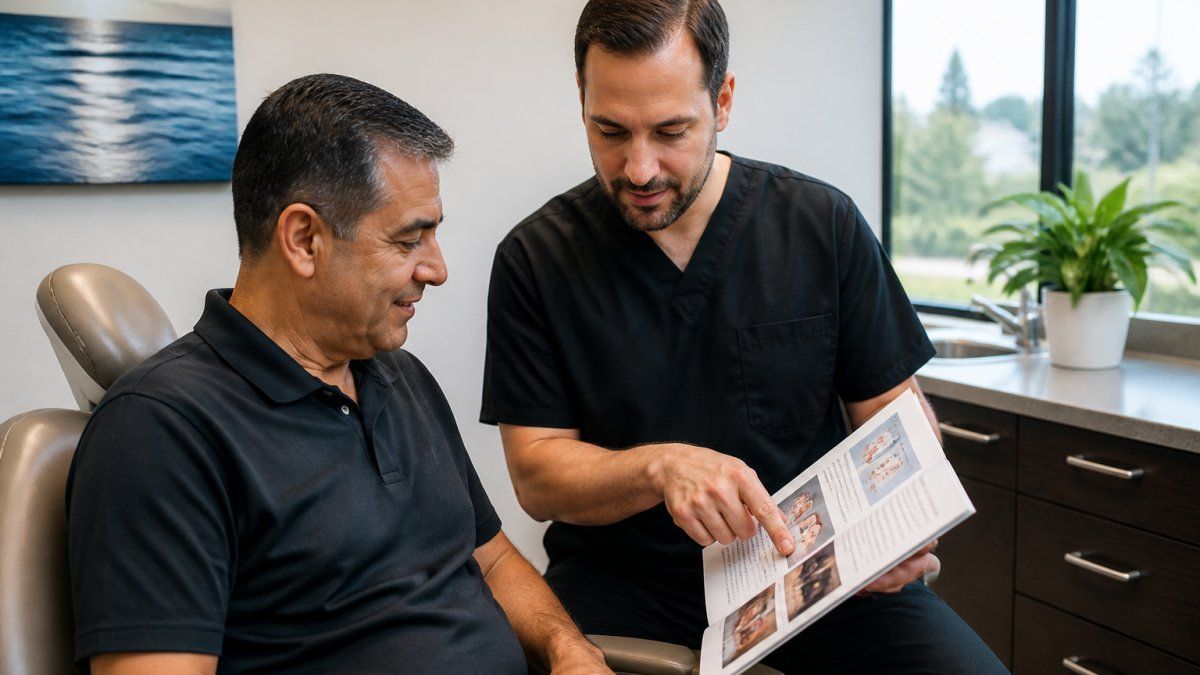
Ask any provider these questions before you commit to treatment. The answers tell you whether the plan fits your situation and whether the pricing is transparent.
- What does the total treatment plan include, and what is not included?
- Is a bone graft or extraction likely, and how would that change the plan?
- Who performs each step of the procedure?
Dental Implant Insurance Coverage: What Plans Usually Pay For
Dental implant insurance coverage varies widely, and many plans classify implants as a major or elective service. Some plans cover part of the crown or the implant itself, while others exclude implants entirely. A common pattern is coverage at a lower percentage than routine care, often subject to an annual maximum.
What most plan summaries do not explain is how an implant claim actually gets processed. That is where patients lose money without realizing it.
How an Implant Claim Usually Moves Through a Plan
An implant is rarely billed as one line item. It is typically broken into separate procedures, and each one may be handled differently:
- Consultation and imaging , often covered as a diagnostic service, sometimes subject to a separate frequency limit on X-rays.
- Extraction of the failing tooth , usually covered as a basic or major service, depending on the plan.
- Bone graft or socket preservation , frequently classified as a major service, and some plans exclude it outright when it is tied to an implant.
That split matters because a plan can pay a meaningful share of the crown and extraction while paying nothing toward the post. A patient who only asks "do you cover implants?" may get a flat no, when the real answer is that parts of the treatment are covered.
Questions to Ask Your Insurer Before You Commit
Call your plan and ask these in order. Write down the answers and the name of the representative you spoke with.
- Is the implant post itself a covered benefit, or is it excluded?
- Is a bone graft covered, and does it require a separate pre-authorization?
- What is my annual maximum, and how much of it is already used this year?
- Is there a waiting period before major services become active?
- Does the plan require pre-authorization before treatment begins?
- Will the plan pay based on the dentist's fee, or on a lower "usual and customary" schedule?
That last question is the one patients most often skip. Even when a plan covers a percentage, it may calculate that percentage against its own allowed amount rather than the actual fee, which changes what you owe out of pocket.
Pre-Authorization and Coordination of Benefits
If your plan offers or requires preauthorization or a predetermination of benefits, submitting the proposed treatment before treatment begins can help you better understand the plan's estimated contribution. Keep in mind that the estimate is not a guarantee of payment, and benefits can change based on eligibility, remaining annual maximums, and plan limitations.
If you have two dental plans, for example, through your own employer and a spouse's, coordination of benefits may allow one plan to pay first and the second to pick up part of the remainder.
When Insurance Will Not Cover Implants
Many plans simply exclude implants, and no amount of paperwork changes that. In those cases, the practical options are financing, a health savings or flexible spending account, a dental savings plan, or choosing a different restorative option such as a bridge or denture.
Dental implant coverage varies widely by plan. Some plans provide benefits for certain implant-related procedures, while others limit or exclude implant coverage. Annual maximums, waiting periods, frequency limitations, deductibles, and plan-specific exclusions can also affect what you pay.
Because plan rules differ so much, the only reliable answer comes from your specific policy. Ask your insurer directly about implant coverage, pre-authorization requirements, and any waiting periods.
| Coverage Question |
Why It Matters |
|---|---|
| Is the implant post covered or excluded? |
Many plans cover the crown but not the post |
| Is a bone graft covered? |
Often classified as major or excluded entirely |
| What percentage is covered? |
Implants often fall under major services |
| Is pre-authorization required? |
Skipping it can reduce your reimbursement |
| Is there an annual maximum? |
Caps how much a plan pays per year |
| Any waiting period? |
New plans may delay coverage |
| Is payment based on usual and customary fees? |
Changes what you owe even when a service is covered |
Dental Implant Financing Options and Lower-Cost Alternatives
Dental implant financing options typically include in-office payment plans, third-party healthcare financing, and health savings or flexible spending accounts. Many patients combine a payment plan with whatever insurance contributes to spread the cost over time.
What matters more than the list is understanding how each option behaves, because they are not interchangeable.
How Each Financing Path Actually Works
In-office payment plans. Many practices offer to split treatment into monthly payments, sometimes with no interest for shorter terms.
Third-party healthcare financing. These are outside lenders or financing companies that pay the practice up front and collect monthly payments from you.
Dental savings plans. These are not insurance. You pay an annual membership fee and receive discounted rates on procedures at participating dentists.
Lower-Cost Alternatives and Their Trade-Offs
A bridge or denture can be a better fit when bone health, budget, or timeline makes an implant impractical. Each option has real trade-offs, and the right choice depends on your examination and goals.
- Dental bridge. Uses neighboring teeth for support. Usually faster and less expensive up front than an implant, but it does not replace the tooth root, and the supporting teeth are typically reshaped. Bridges also have a shorter average lifespan and may need replacement.
- Partial denture. Removable and typically the lowest up-front cost for replacing several teeth. A partial denture does not provide the same type of jawbone stimulation as an implant, and the underlying bone can continue to change over time.
- Full denture. Replaces an entire arch. Often the most affordable way to restore function across many missing teeth, but retention and fit change over time as the jawbone shrinks, which may require relines or replacements.
Dental Schools and Community Clinics
Dental schools and community clinics sometimes offer implant treatment at reduced rates because care is provided by supervised students or residents. The trade-offs are longer appointment times, more visits, and less flexibility in scheduling. Availability and eligibility vary, so it is worth calling ahead to ask whether implant treatment is offered and what the screening process looks like.
A Practical Way to Compare Options
When you request a quote from our office, we can walk you through what each option looks like for your plan.
Before choosing, line up three numbers side by side: the total treatment cost, what insurance is expected to pay, and the monthly amount you would owe under each financing path. That comparison usually makes the decision much clearer than the headline price alone.
What to Avoid When Comparing Implant Providers
Watch for quotes that leave out key steps, pressure you to decide the same day, or skip a proper examination. A trustworthy provider explains the plan, the risks, and the alternatives before asking for a commitment. Any treatment recommendation should follow a real exam, not a phone estimate.
- No written, itemized treatment plan
- Pressure to commit immediately
- Vague answers about who performs the procedure
Your Next Step Toward Affordable Dental Implants in Ventura
If you are considering dental implants in Ventura, a consultation is a good place to start. At Jonathan Arias DDS, we evaluate your oral health, discuss your treatment options, and provide a clear treatment plan based on your individual needs.
We welcome new patients and work with many major dental insurance plans. Request an appointment with our Ventura office to discuss your options, estimated costs, and next steps.
Frequently Asked Questions
How can I get dental implants if I can't afford them?
Start by asking each dental office for a written treatment plan that lists every component: the implant, abutment, crown, imaging, and any bone graft or extraction. That itemized plan makes it easier to compare providers and see where costs come from. Ask whether the practice offers in-house payment plans or works with third-party financing companies, and check whether your dental insurance plan covers any portion. Some patients also combine a health savings account with a monthly payment plan to spread the cost over time. A consultation is the best place to get numbers specific to your case.
What should I ask at a dental implant consultation?
Ask who will place the implant and who will restore it, how many implant procedures they perform regularly. Request a written, itemized treatment plan and ask what happens if the implant fails or needs additional treatment. Ask about the estimated timeline, whether a bone graft or extraction is needed, and what sedation or comfort options are available. Finally, ask how the office handles insurance claims and whether they offer financing. Bring your questions in writing so nothing gets missed.
Does dental insurance cover dental implants?
Coverage varies widely by plan. Many dental insurance plans classify implants as a major restorative service and may pay a percentage of the cost after a deductible, up to an annual maximum. Some plans exclude implants entirely or require pre-authorization before treatment begins. Because plan rules differ, ask your insurance provider directly whether implants are covered, what percentage is paid, and whether a pre-treatment estimate is required. The dental office can often submit a pre-treatment estimate so you know your out-of-pocket share before you commit.
How do I know if I am a candidate for dental implants?
Candidacy depends on several factors a dentist evaluates during an examination, including the health of your gums, the amount and quality of bone in the jaw, your overall health, and whether you smoke. Conditions like uncontrolled diabetes or certain medications can affect healing and may need to be addressed first. Some patients need a bone graft before an implant can be placed. There is no way to confirm candidacy without an in-person exam and imaging, so schedule a consultation if you are considering implants.
Missing teeth affect more than your smile; they change how you eat, speak, and feel day to day. At Jonathan Arias DDS, we offer personalized restorative care, transparent pricing, and a comfortable, anxiety-free environment so you can move forward with confidence. Request an appointment with our Ventura office and get a clear, itemized plan built around your needs.